
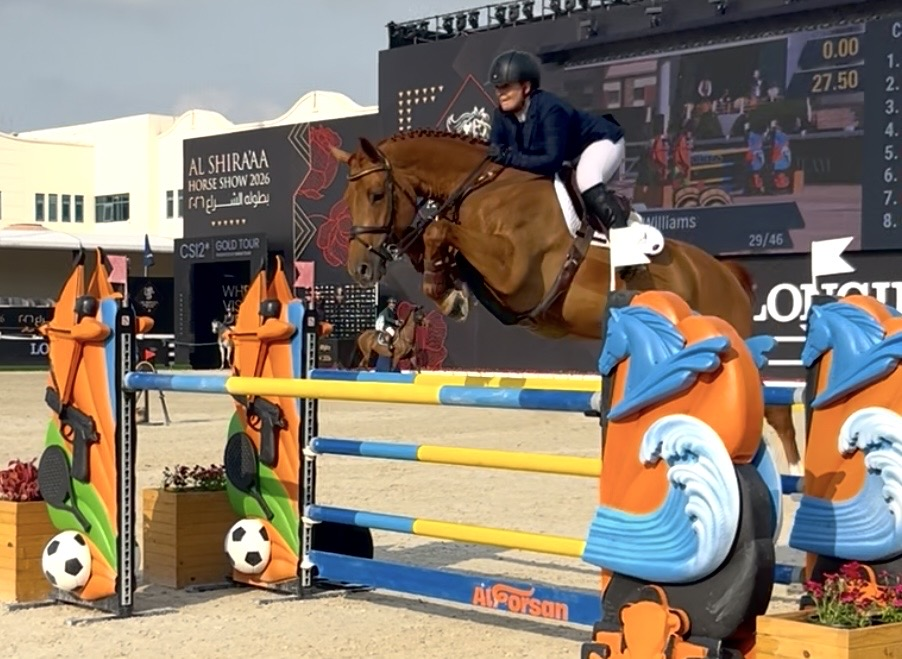
The UAE Competition Season Is Underway
The 2026–27 competition season is starting across the UAE, with the first show jumping fixtures at Sharjah Equestrian & Racing Club on 26–27 September, followed by Boudheib Equestrian Academy in Abu Dhabi on 3–4 October.
The current racing calendar also lists early meetings at Meydan on 30 September and Jebel Ali on 7 October, followed by racing across Al Ain, Abu Dhabi and Sharjah later in October.
| Discipline | Date | Venue |
|---|---|---|
| Show Jumping | 26–27 September | Sharjah Equestrian & Racing Club |
| Racing | 30 September | Meydan |
| Show Jumping | 3–4 October | Boudheib Equestrian Academy, Abu Dhabi |
| Racing | 7 October | Jebel Ali |
Competition schedules continue to be updated throughout the season. For the latest show jumping, dressage and endurance dates, view the full UAE Equestrian & Racing Federation calendar. For racing, view the current Emirates Racing Authority season calendar.
Whether your first competition is just around the corner or later in the season, now is a good time to make sure your horse is physically prepared for the workload ahead.
Your Pre-Competition Season Checklist
1. Book a physiotherapy assessment
A pre-season physiotherapy assessment can be useful for identifying areas of muscular tension, reduced mobility, asymmetry or weakness before the horse moves into a busier period of work.
Regular physiotherapy throughout the competition season can help to keep the horse comfortable and performing at their best. Treatment may include manual therapy, mobilisations, stretching, electrotherapy and remedial exercise depending on the individual findings, as well as recommendations for strengthening exercises and stretches between treatments.
Prevention is better than rehab!
2. Check saddle fit
Changes in topline, muscle development, body condition and workload can all affect how a saddle fits.
A saddle that fitted well several months ago may not necessarily fit the same way now, particularly if the horse has had time off or has changed shape through training.
Incorrect saddle fit may contribute to asymmetries, changes in muscle development, back discomfort and poor performance.
3. Make sure dental care is up to date
Dental discomfort can affect contact, head carriage, chewing, acceptance of the bit and overall comfort during ridden work.
If your horse is due a dental examination, it is better to address it before competition becomes busy rather than waiting until a problem develops.
4. Check vaccinations and competition paperwork
Make sure vaccinations, passport details and any competition requirements are up to date before entries start going in.
It is much easier to sort these things in advance than realise something is missing a few days before a show.
5. Build fitness progressively
Fitness should be developed gradually rather than suddenly increasing workload because the competition calendar has started.
A well-rounded programme might include flatwork, hacking, pole work, hill work where appropriate, transitions, strengthening exercises and discipline-specific training.
For a show jumper, that does not mean simply jumping more frequently. For an endurance or racehorse, it does not mean only increasing speed or distance.
The aim is to prepare the whole body for the demands of the sport, providing a variety of exercises including groundwork, pole work, hacking and schooling, alongside exercises advised by your physiotherapist.
6. Plan recovery as carefully as training
Recovery is as important as training — the body needs time to rest and adapt to training.
Harder schooling sessions and competitions should be balanced with appropriate lower-intensity work and rest. Depending on the individual horse, this may include hacking, turnout, walking or lighter schooling days.
It is also worth paying attention to how your horse feels after harder work or competition.
Are they moving normally the following day? Do they seem unusually stiff? Are they taking longer to recover as the season progresses?
Looking at recovery can tell you a lot about whether your horse is coping with their current workload. Appropriate rest and variation in training are also important for keeping the horse comfortable and happy both mentally and physically.
7. Review nutrition, hydration and body condition
A horse beginning a busier competition period may have different nutritional and hydration needs compared with a quieter period.
Monitoring body condition, energy levels, appetite and recovery can help identify whether the horse is coping well with the increased workload.
8. Pay attention to the small changes
Not every physical issue begins with obvious lameness.
Changes such as increased stiffness, difficulty on one rein, reluctance to pick up a particular canter lead, reduced engagement, changes in jumping technique, new girthiness or taking longer to warm up can all be signs your horse may need a physiotherapy assessment.
The earlier a change is noticed, the easier it is to decide whether the horse simply needs an adjustment to training or whether further assessment is appropriate.
How Can Physiotherapy Support Performance?
Physiotherapy isn't only for horses recovering from injury. For a competition horse, it can help monitor and address changes in mobility, muscular tension, symmetry and strength as workload increases.
Small physical changes may show up in performance before they become an obvious problem. A show jumper may begin knocking poles or changing technique, a dressage horse may become stiffer on one rein, while an endurance or racehorse may take longer to loosen up or recover after harder work.
Where muscular tension, restricted mobility, weakness or compensatory movement are contributing, physiotherapy and targeted exercise can help support more comfortable, efficient movement.
Training and Physiotherapy Should Work Together
One treatment cannot replace good training. Physiotherapy cannot compensate for an inappropriate workload, and training cannot simply override discomfort.
A well-rounded approach gives the horse the best opportunity to cope with the demands being placed on them.
Long-term improvements in strength, fitness and movement come from the work done consistently between appointments.
This is where remedial exercise programmes can be particularly useful and recommended to achieve the most benefit between treatments.
Depending on the individual horse, exercises may be advised to improve strength, mobility and comfort, including pole work, transitions, dynamic mobilisation exercises, controlled backing-up, core and postural exercises or specific strengthening work.
The horse's normal training should also remain varied where possible. Flatwork, hacking, poles, strengthening work and discipline-specific training can complement each other rather than repeatedly loading the body in exactly the same way.
Physiotherapy and Injury Prevention
Can physiotherapy prevent an injury?
No treatment can guarantee that a competition horse will remain injury-free. Injury risk is influenced by many factors including training load, previous injury, fatigue, surfaces, conformation and the demands of the horse's individual discipline.
But physiotherapy can still form an important part of a preventative approach.
Regular assessment can help monitor changes in muscular symmetry, mobility and movement over time. If an area of weakness or restriction is identified, targeted treatment and strengthening exercises can be introduced rather than simply waiting for a more significant problem to develop.
Perhaps more importantly, it encourages riders to recognise changes early.
A horse becoming consistently stiffer, struggling with something they previously found easy or recovering differently after work deserves attention — even if they are technically still sound.
When Should a Competition Horse See a Physiotherapist?
There is no perfect treatment interval that suits every horse.
A horse undergoing rehabilitation may need much closer monitoring than a healthy competition horse receiving occasional maintenance treatment.
Useful times to consider a physiotherapy assessment include:
- before increasing workload for the new season
- when returning to work following time off
- during rehabilitation or a structured return-to-work programme
- when moving up a level in training or competition
- following a particularly demanding period of competition
- if there is a consistent change in movement, behaviour or performance
Treatment frequency should be based on the horse's individual findings, workload, history and goals rather than automatically treating every horse at the same interval.
Research Spotlight: Do Simple Exercises Actually Make a Difference?
One of the things I regularly incorporate into treatment and rehabilitation programmes is dynamic mobilisation exercises — including baited stretches, belly lifts and other targeted exercises.
A recent study investigated whether dynamic mobilisation exercises could influence movement in horses. Eight horses completed a programme of dynamic mobilisation exercises three times per week, while six horses continued their normal routine without the exercise programme.
Changes began to appear during the programme, with the exercise group showing improvements in several movement parameters. By week six, stride length and locomotor symmetry had improved compared with earlier measurements.
This builds on earlier research into dynamic mobilisation exercises. A 2022 study involving eight horses found that seven weeks of dynamic mobilisation exercises increased the cross-sectional area of the multifidus muscles — small stabilising muscles running alongside the spine — by approximately 13% in the exercise group.
These studies are particularly interesting from a physiotherapy perspective because they demonstrate that relatively simple, targeted exercises can produce measurable physical changes.
This research supports the value of purposeful, progressive exercise as part of equine rehabilitation and conditioning, showing that simple, targeted exercises performed consistently can produce measurable changes in the horse's musculature and movement.
Preparing for Competition Season?
Vet Physio Abu Dhabi provides mobile equine physiotherapy across Abu Dhabi and the UAE, supporting competition horses through performance management, rehabilitation, return to work and preventative care.
Every appointment begins with a detailed clinical assessment before treatment and any remedial exercises are tailored to the individual horse.
Whether you are preparing for competition in Abu Dhabi, Al Ain, Sharjah, Dubai or elsewhere across the UAE, if your horse's workload is increasing or something simply doesn't feel quite the same, get in touch to arrange an equine physiotherapy assessment.
Book an equine physiotherapy appointment with Vet Physio Abu Dhabi.
References
Saitua A, Pérez-Umbría J, García-Álamo K, Muñoz A. Dynamic Mobilization Exercises Improve Activity and Stride Parameters Measured with Accelerometry in Sedentary Horses. Animals. 2025;15(20):2943.
Gómez Lucas R, Rodríguez-Hurtado I, Troteaga Álvarez C, Ortiz G. Effectiveness of Neuromuscular Electrical Stimulation and Dynamic Mobilization Exercises on Equine Multifidus Muscle Cross-Sectional Area. Journal of Equine Veterinary Science. 2022;113:103934.
Stubbs NC et al. Dynamic mobilisation exercises increase cross sectional area of musculus multifidus. Equine Veterinary Journal. 2011;43(5):522–529.
UAE Equestrian & Racing Federation. Show Jumping Calendar — Season 2026–2027.
Emirates Racing Authority. Current Season Calendar — 2026–2027.